
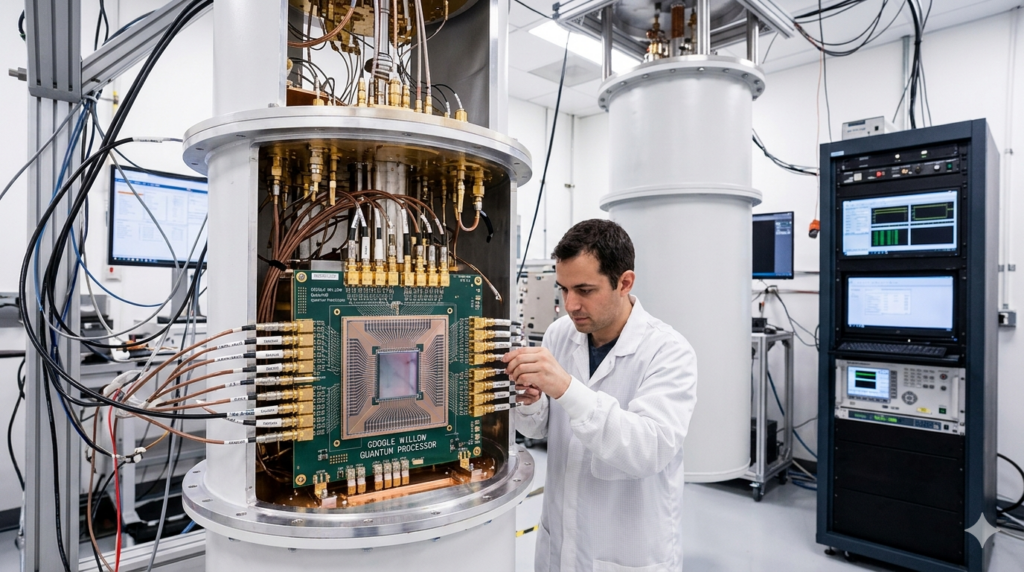

Imagine a computer that doesn’t just crunch numbers, but explores countless possibilities at once. That’s the promise of quantum computing, and Google just took a major step toward making it real with a new chip called Willow.
Willow has 105 qubits—the quantum version of regular computer bits. But unlike normal bits that are either zero or one, qubits can be both at the same time. This lets quantum computers tackle certain complex problems much faster than even the world’s most powerful supercomputers.
What makes Willow special? Two things. First, Google solved a long-standing problem: as they added more qubits, the error rate actually got smaller instead of worse. That’s huge because errors have been the main thing holding quantum computers back.
Second, Willow completed a super complex calculation in just five minutes. The same task would take today’s fastest supercomputer an unbelievable 10 septillion years—that’s a one followed by 25 zeros. For context, the universe is only about 13.8 billion years old.
This doesn’t mean your laptop will be quantum anytime soon. Willow’s achievement is in a very specific type of problem designed to test quantum machines. But it’s a clear sign that practical quantum computing is getting closer.
Scientists hope quantum computers will one day help discover new medicines, design better batteries, and solve other problems that are currently impossible.
The road ahead still has big challenges, but Willow shows real progress. The quantum future might be closer than we thought.