
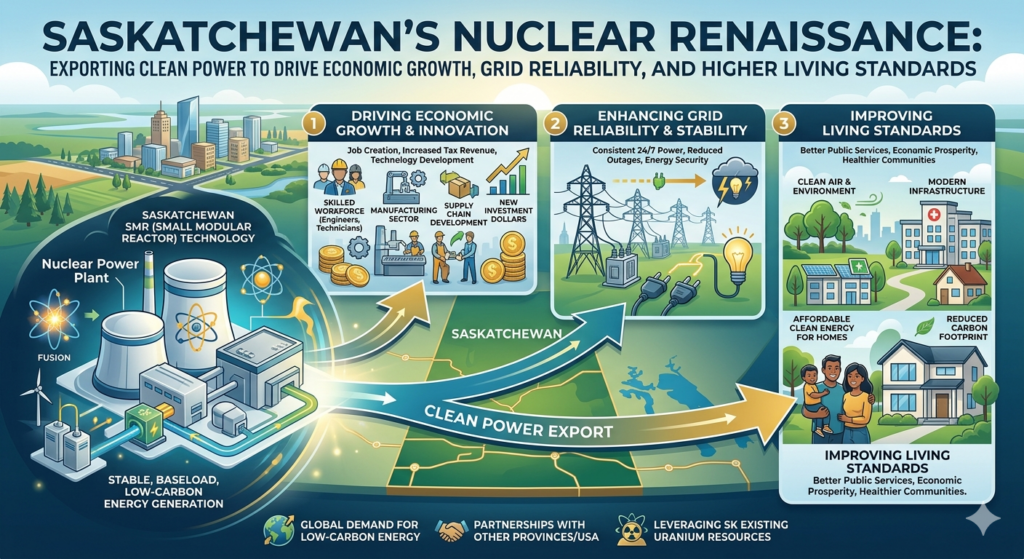

Saskatchewan stands at the threshold of a transformative energy future. With the world’s largest high-grade uranium deposits in the Athabasca Basin and a clear provincial strategy to harness them, the province is actively pursuing nuclear power generation through small modular reactors (SMRs) and large-scale reactors. Under the Saskatchewan First Energy Security Strategy and Supply Plan released in October 2025, SaskPower is advancing nuclear as a cornerstone of reliable, carbon-free baseload electricity. This isn’t just about meeting domestic demand—it’s about positioning Saskatchewan as a net exporter of clean power to other Canadian provinces and the United States, while delivering massive economic returns, job creation, tax relief potential, and an elevated standard of living for residents.
Nuclear Power Plans: From Uranium Riches to Reactors
Saskatchewan already leads globally in responsible uranium production, with the sector currently supporting over 3,300 direct and indirect jobs and recent approvals for major new mines (NexGen’s Rook I and Denison’s Wheeler River) expected to add 1,600 construction jobs, 700 ongoing operational roles, and a staggering $32.5 billion in economic impact from just one project alone. These mines will fuel not only exports of raw uranium but domestic nuclear power.
SaskPower selected GE Hitachi’s BWRX-300 SMR technology in 2022, with site selection near Estevan targeted for late 2026, a final investment decision by 2029, and potential first power in the mid-2030s. In January 2026, the province announced a parallel evaluation of large nuclear reactor technologies to meet industrial and regional demand—work that could bring online additional capacity in 15–20 years. Both pathways leverage Saskatchewan-mined uranium for fuel, ensuring supply chain security and maximizing local value.
Nuclear delivers 24/7, zero-emission baseload power—one SMR can supply 300,000 homes continuously—perfect for Saskatchewan’s growing needs from agriculture, mining, and data centers, while enabling exports.
Upgrading the Power Grid: The Essential Backbone for Exports
Nuclear reactors alone won’t export power without transmission capacity. Saskatchewan’s grid currently has strong north-south reliability and limited interties, but major upgrades are underway to unlock export potential.
The February 2026 report Strengthening Saskatchewan’s Grid: Transmission to Power Communities and Growth outlines three pillars:
- Reinforcing the existing provincial grid for reliability and load growth.
- Building new northern transmission, including the first-ever connection between northern and southern systems (two ~250 km lines approved in March 2026, targeting completion by 2032) to support northern industry and energy security.
- Expanding interprovincial and international interconnections, including new links to the U.S. Southwest Power Pool (SPP) by 2027 and participation in the March 2026 National Energy Corridor MOU with multiple provinces.
These upgrades will allow Saskatchewan to export surplus baseload power eastward to Manitoba or Ontario, westward to Alberta, and south to U.S. markets hungry for reliable clean energy. As Minister Jeremy Harrison stated, “Together with expanded intertie capacity, nuclear power will make Saskatchewan an export powerhouse and safeguard Saskatchewan’s energy security far into the future.” Expanded transmission will also generate direct revenue from power sales while improving grid resilience during peaks or outages.
Economic Boom: Jobs Across Mining, Energy, and Beyond
The economic multiplier from nuclear is profound. Canada’s nuclear sector already contributes $22 billion annually to GDP and employs 89,000 people, with median wages 30% higher than other energy industries. Saskatchewan’s uranium operations alone added $2.6 billion to the national economy in 2024 and support over 3,400 jobs (nearly half in the north, with strong Indigenous participation at 39–43%).
Reactor development will amplify this:
- Mining expansion: New mines and expanded production will sustain and grow high-paying northern jobs (average salaries 1.9 times provincial norms).
- Construction and operations: SMR and large-reactor builds will create thousands of trades jobs during multi-year construction phases, followed by stable, high-skill operating roles. Similar Ontario SMR projects project 1,956 jobs per year during construction and 3,700 annually for decades afterward.
- Spillover industries: Supply chain manufacturing (fuel fabrication, components), workforce training (University of Regina’s new SMR Safety Licensing and Testing Centre), engineering, logistics, and even hydrogen/ammonia production using nuclear heat. Indirect jobs multiply 7:1 or more, touching transportation, hospitality, retail, and tech. Provincial reports project generational careers and infrastructure investments across the north and beyond.
With global SMR export markets potentially reaching $150 billion (2030–2040), Saskatchewan could export not just power but reactor technology and expertise, further boosting GDP.
Revenue, Tax Cuts, and a Higher Standard of Living
Proper government management of nuclear revenue—through uranium royalties, power export sales, and corporate taxes—could deliver direct fiscal dividends. Energy exports via upgraded interties will create new revenue streams for SaskPower and the province, much like resource royalties today. With Saskatchewan’s focus on fiscal responsibility and “Saskatchewan First” priorities, surplus funds could translate into personal income tax cuts, reduced property taxes, or targeted rebates—freeing up household income for families in Saskatoon, Regina, and rural communities.
Affordable, reliable nuclear power keeps electricity rates stable (nuclear is among the lowest-cost baseload options long-term), reducing energy poverty and business costs. This ripples into higher disposable incomes, better-funded public services (healthcare, education, roads), and attraction of new industries. Northern and Indigenous communities, already benefiting from mining equity partnerships, will see even greater gains in training, procurement, and infrastructure—directly lifting living standards province-wide.
Canada-wide nuclear data shows the sector generates billions in government revenue through taxes; scaled to Saskatchewan’s uranium advantage and export focus, the province could mirror resource-rich models where energy wealth funds tax relief without compromising services.
A Vision Worth Building
Saskatchewan building nuclear reactors isn’t a distant dream—it’s underway, backed by provincial strategy, federal partnerships, and private investment. By upgrading the grid for seamless exports, the province transforms from energy importer/consumer to clean-power exporter, powering homes and industries from Vancouver to Chicago while creating thousands of well-paid jobs in mining, construction, operations, and spillover sectors.
With prudent management, the resulting revenue surge can deliver meaningful tax cuts, stabilize costs, and elevate the standard of living for every Saskatchewan resident. This nuclear-powered future secures energy independence, drives economic diversification, and cements Saskatchewan’s role as a North American energy leader.
The time to act is now. Saskatchewan’s uranium, ingenuity, and strategic investments position us to export not just megawatts—but prosperity—for generations to come.