
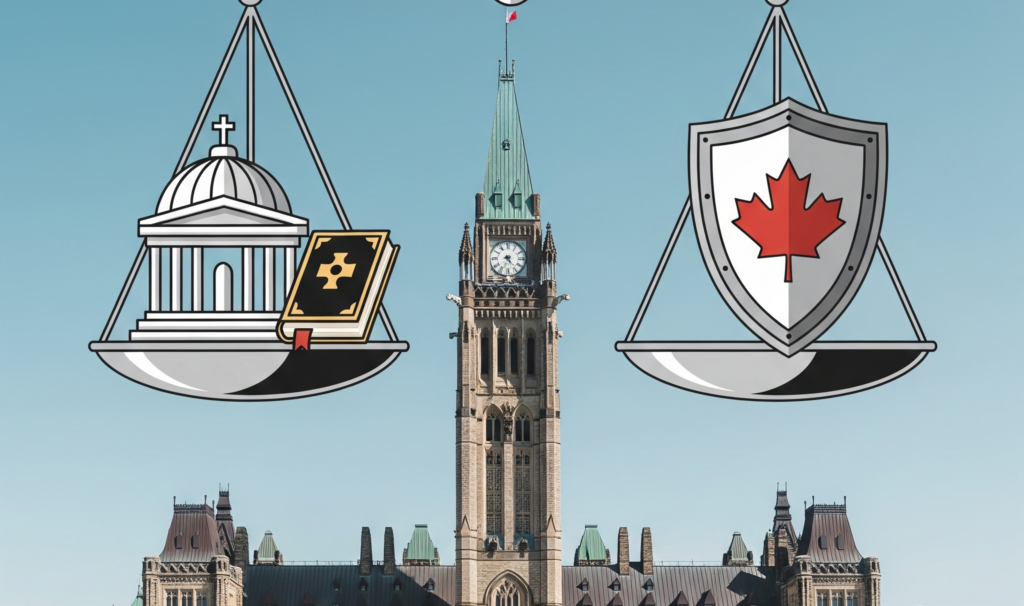

Bill C-9, officially titled “An Act to amend the Criminal Code (hate propaganda, hate crime and access to religious or cultural places)” or the “Combatting Hate Act,” is a government bill introduced by the Minister of Justice on September 19, 2025 (in the 45th Parliament, 1st session). It passed third reading in the House of Commons on March 25, 2026 (by a vote of roughly 186-137, with Liberals and Bloc Québécois support), and as of early April 2026 it is before the Senate at second reading.
Official Breakdown of What the Bill Does
The bill amends the Criminal Code in response to reported rises in hate-motivated incidents (especially antisemitism after October 7, 2023). Its core goals, per the government and Justice Canada, are to:
- Protect access to sensitive community spaces.
- Explicitly denounce and punish hate-motivated offending.
- Ban certain public displays of hate/terror symbols.
- Streamline some prosecutions while codifying existing case-law standards.
Key new or changed provisions (from the third-reading text):
- New “hate crime” add-on offence (new s. 320.1001): If you commit any Criminal Code (or other federal) offence and it is motivated by “hatred” against an identifiable group (race, national/ethnic origin, religion, sex, sexual orientation, gender identity/expression, age, disability, etc.), you face an extra charge with enhanced penalties (scaled up to life imprisonment depending on the base offence). This is designed to make sentencing harsher and send a stronger denunciation message.
- Intimidation offence (new s. 423.3(1)): Engaging in conduct intended to provoke fear in someone to stop them accessing a “protected place” (buildings primarily used for religious worship; community, cultural, social, sports, educational, or administrative purposes by an identifiable group; schools/daycares; seniors’ residences; or cemeteries). Up to 10 years imprisonment.
- Obstruction offence (new s. 423.3(2)): Intentionally obstructing or interfering with lawful access to the same protected places (exception for people who are only there to communicate information). Same penalties.
- New hate-propaganda offence for symbols (new s. 319(2.2)): Wilfully promoting hatred against an identifiable group by publicly displaying (a) symbols of listed terrorist entities, (b) the Nazi Hakenkreuz (swastika), (c) Nazi SS bolts, or (d) anything that “so nearly resembles” them. Up to 2 years. New defence: legitimate purpose (e.g., journalism, education, art, not contrary to public interest) or good-faith attempt to highlight the symbol for removal.
- New statutory definition of “hatred” (s. 319(7), applied broadly): “an emotion of an intense and extreme nature that is clearly associated with vilification and detestation” — explicitly stronger than mere disdain or dislike. This codifies Supreme Court language from Whatcott (2013) and is meant to clarify (and supposedly narrow) what counts.
- Major procedural changes:
- Repeals the Attorney General consent requirement for some hate-propaganda proceedings (s. 318), but keeps it for the main s. 319 offences (including the new symbol one).
- Repeals the long-standing “good faith religious defence” in s. 319(3)(b) and (3.1)(b): No longer a defence to claim you were expressing an opinion on a religious subject or based on a religious text in good faith. (This was added via committee amendment as part of a Liberal-Bloc deal and is the most controversial part.)
Other tweaks: Easier DNA sampling, bail conditions, forfeiture of hate materials, etc.
The government’s Charter statement claims no violations of s. 2 (expression, religion, assembly) because of intent requirements, exceptions, and judicial discretion. Critics disagree.
Pros and Cons for Citizens
Pros (mainly for members of identifiable/minority groups):
- Stronger tools against real-world harassment: Mobs blocking synagogue/mosque/pride centre/school entrances or using terror symbols to intimidate become explicitly criminal with serious penalties. This directly addresses documented spikes in incidents.
- Harsher sentences for bias-motivated violence/assaults/etc. send a clear societal signal and may deter some offenders.
- Clearer rules on overt symbols (swastikas, ISIS flags) reduce the “normalization” of extremism in public.
Cons (for everyone, especially religious people, protesters, and dissenters):
- Chills religious speech: Pastors, imams, rabbis, or anyone quoting scripture on topics like sexuality, other faiths, or morality can no longer point to the 40-year “good faith religious text” defence. A prosecutor/jury deciding your sermon “wilfully promoted hatred” (under the new definition) could lead to charges. The “for greater certainty” clause added later is vague and does not restore the old protection.
- Vague, overbroad protest offences: “Intimidation” (provoking fear) or “obstruction” near any community centre/school/church used by a group is now criminal if intent is inferred. Peaceful but loud pickets, sit-ins, or counter-protests (pro-life at churches, anti-gender-ideology at schools, pro-Palestine at Jewish centres) risk charges. The “communicating information” exception is narrow.
- Easier charging + subjective “hatred” motivation: Any minor offence (trespass, mischief) can become a serious “hate crime” add-on. Police/prosecutors have more discretion without full AG oversight in some areas; selective enforcement is inevitable.
- Self-censorship: People will avoid discussing controversial religious, political, or cultural topics online or in public to avoid complaints that trigger investigations.
Net for average citizen: If you’re in a group that’s been targeted by violence or blockades, you probably feel safer on paper. If you value open debate, religious practice, or protest rights, your legal risks just went up significantly.
Pros and Cons for Politicians
Pros:
- Quick political win: Looks tough on hate, appeals to Jewish, Muslim, 2SLGBTQ+, immigrant, and progressive voters who report feeling unsafe. Jewish advocacy groups largely supported it.
- Low-cost signalling: No new spending required; frames opponents (especially Conservatives who fought the religious-defence repeal) as soft on antisemitism/racism.
- Future leverage: Expanded tools for future governments (of any stripe) to target “hate” as they define it.
Cons:
- Massive backlash from faith communities (Catholic bishops, evangelicals, some Muslim groups), civil liberties organizations (CCLA, Canadian Constitution Foundation), labour unions, and free-speech advocates. Accusations of “censorship” and “thought policing” stick.
- Charter challenges almost guaranteed: Overbreadth, vagueness, and the religious-defence repeal will be litigated for years — expensive for taxpayers and potentially embarrassing if courts strike parts down.
- Divisive legacy: Enforcement will be weaponized in culture-war battles (e.g., gender, Israel/Palestine, immigration). Future opposition can campaign against it as an attack on Canadian values.
- Risk of blowback: If it leads to high-profile wrongful prosecutions or plea deals, public trust in justice erodes further.
The Brutal Truth and Possible Outcomes
This isn’t nuanced reform — it’s a classic expansion of state power over speech and assembly sold as “combatting hate.” Canada already had strong hate-propaganda and hate-crime laws (ss. 318-320, plus sentencing principles). Real hate crimes were already prosecutable as mischief, assault, threats, etc. The spike in incidents is real (StatsCan data shows antisemitic and anti-Muslim crimes up sharply), but the root causes (failed integration, online radicalization, selective policing, geopolitical tensions) aren’t fixed by new Criminal Code sections.
Good possible outcomes:
- Fewer physical blockades and overt Nazi/terror symbols in public — immediate relief for targeted communities.
- Some deterrence: Extra penalties and easier add-on charges might make opportunistic thugs think twice.
- Symbolic unity: Marginalized groups feel the state has their back, potentially reducing vigilante responses.
Bad (and more likely long-term) outcomes:
- Erosion of free speech and religion: The religious-defence repeal is the killer — sincere believers lose a shield that protected preaching for decades. Expect more cautious sermons, self-censored social media, and underground resentment. “Hatred” is still ultimately a jury’s feeling; “fear” and “primarily used by” are broad enough for abuse.
- Selective enforcement and politicization: Progressive prosecutors will hammer right-wing/religious speech; conservative ones (if any) might target left-wing protests. Plea-bargain pressure will rise because fighting a “hate” charge is career-ending even if you win.
- Chilled protest culture: Blockades of pipelines, pipelines, or government buildings near “community” sites become riskier. Canada’s tradition of loud but lawful demonstration takes a hit.
- No real reduction in underlying hate: Criminal law doesn’t change hearts or fix integration failures. It may even fuel backlash (“they’re criminalizing our views”).
- Legal chaos: Multiple Charter challenges, inconsistent enforcement across provinces, and years of uncertainty until the Supreme Court weighs in (likely striking the vaguest parts but leaving a narrower but still expanded law).
- Slippery slope: Once “displaying symbols” and “provoking fear” near group spaces are normalized, pressure will grow for even broader speech codes.
In short: The bill will probably pass the Senate with minor tweaks and become law. Short-term, it gives politicians applause lines and some communities breathing room. Long-term, it makes Canada a little less free, a little more divided, and a little more like a country where the state decides which opinions are hateful. The brutal reality is that hate is real, but legislating emotions and symbols while gutting religious-speech protections is how free societies slowly trade liberty for security — and end up with neither. If you care about this, contact your Senator now; once it’s law, fixing it will take years and court battles.