
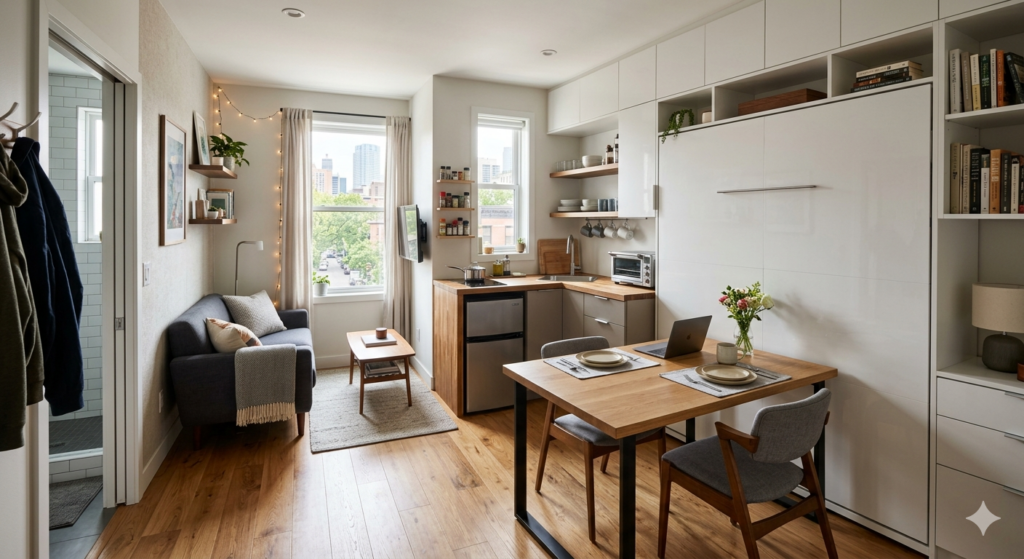

Canada’s housing crisis shows no signs of easing in 2026. National average home prices hover around $653,000, with Toronto exceeding $1 million, Vancouver over $1.2 million, and even Montreal at $657,000. Rents remain punishing in major cities, where a one-bedroom can easily top $2,500–$2,800 monthly in high-demand areas. Affordability has deteriorated beyond the usual suspects—spreading to Ottawa, Halifax, and parts of the Prairies—leaving many Canadians spending over 30% of income on shelter.
CMHC estimates Canada needs nearly double current construction rates—up to 480,000 new homes annually—to restore pre-pandemic affordability levels. Traditional single-family homes and large condos are too expensive to build and buy at scale. But a smarter model exists: smaller, thoughtfully designed 2- to 3-room modern condos featuring engineered Murphy-style fold-away systems, flooded with natural light, stacked in 3–4 residential towers above a vibrant mixed-use podium that includes parking, retail, and essential services. This approach could slash per-unit costs by 30–50% while delivering comfortable, functional homes for renters and buyers alike.
The Design: Small Footprint, Big Livability
Imagine a 450–650 sq ft condo with two or three versatile rooms. No wasted space on a dedicated bedroom that sits empty all day. Instead, a well-engineered Murphy bed—modern versions use counterbalanced mechanisms, premium mattresses, and seamless cabinetry—folds away into a stylish wall unit that doubles as shelving, a desk, or entertainment centre when not in use. These aren’t the clunky 1950s versions; today’s designs are attractive, quiet, and support up to 800 lbs, blending seamlessly into mid-century modern or minimalist interiors.
Example of a sleek, space-saving Murphy bed integrated into a bright, modern living space.

Another elegant built-in Murphy option with natural wood finishes and ample windows.

The Podium Model: One Base, Multiple Towers, Built-In Amenities
Ground-level podiums—common in successful Canadian projects like Toronto’s The Well or Vancouver’s Oakridge Centre—house parking, grocery stores, pharmacies, cafés, gyms, and services, creating a mini-mall for residents. Above it, 3–4 high-rise towers (20–50 storeys) share elevators, structural foundations, and utilities, spreading land and infrastructure costs across hundreds of units.
Vision of a modern mixed-use development with retail at the base and residential towers rising above, complete with integrated public spaces.

Another example of vibrant ground-floor retail and services supporting upper-level housing in a dense urban setting.

Why this cuts costs dramatically:
- Land efficiency: One podium footprint supports 300–600+ units instead of sprawling suburbs. Land (the biggest expense in cities) is amortized across far more homes.
- Construction savings: Smaller units require less concrete, steel, and finishes per home. Prefab or modular Murphy systems speed assembly. Mixed-use podiums generate retail revenue that subsidizes residential construction—developers recoup faster.
- Lower ongoing costs: On-site shopping and services slash transportation expenses (no car needed for basics). Integrated parking reduces the need for expensive surface lots or off-site garages. Energy-efficient designs and natural light lower utility bills.
- Financing advantages: CMHC programs like the Apartment Construction Loan Program and MLI Select already incentivize affordable rentals and mixed-use with lower rates and premiums. Smaller mortgages (e.g., $250,000–$400,000 per unit vs. $800,000+) become accessible for first-time buyers or investors.
Result? A 500 sq ft condo could rent for $1,200–$1,800/month or sell for $300,000–$450,000 in major markets—30–50% below current averages—while feeling spacious and luxurious.
Proven in Canada, Scalable Nationwide
Mixed-use podium-and-tower projects already thrive in Toronto, Vancouver, Burnaby, and Montreal, delivering walkable communities that boost local economies and reduce car dependency. Scaling this nationwide—targeting Toronto, Vancouver, Montreal, Calgary, Edmonton, Ottawa, and Halifax—aligns with CMHC’s push for “missing middle” and innovative supply. Zoning reforms (already underway in many provinces) could fast-track approvals for podium-based towers on underused commercial land.
Challenges like NIMBY opposition or upfront podium costs are manageable with government incentives, density bonuses, and public-private partnerships. The payoff: more homes faster, vibrant neighbourhoods, and genuine affordability.
A Path to Livable, Affordable Cities
Smaller doesn’t mean cramped when design is intentional. These modern condos—bright, adaptable, and amenity-rich—offer dignity and convenience without the crushing debt or rent burden. By building them across Canada’s major cities, we could house the next generation affordably while revitalizing downtowns.
It’s not science fiction; the technology, examples, and policy tools exist today. Policymakers, developers, and planners should prioritize this model. Canadians deserve housing that works for real lives—not just bigger balance sheets. The blueprint is here: compact, clever, and connected. Let’s build it.