
EmpowerPool: A Modernized Banking System for Collective Purchasing Power
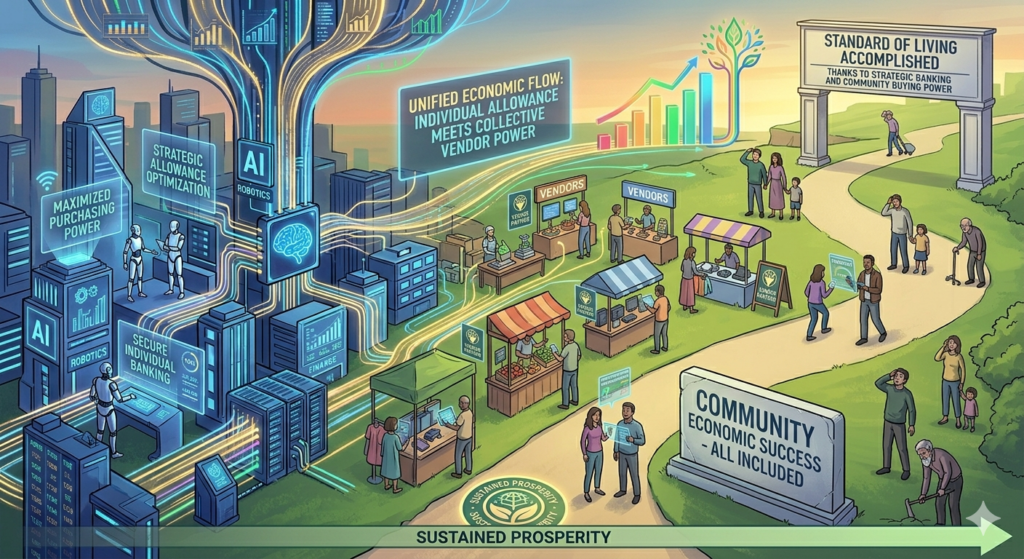
This solution plan outlines a complete blueprint for modernizing traditional banking into EmpowerPool, a hybrid fintech-credit union/bank platform. It directly addresses your vision: individual users allocate personalized allowances (budgeted portions of income, savings, or recurring deposits) into secure, category-specific pools. The system aggregates these across thousands or millions of participants to create massive collective buying volume. This unlocks negotiated premium deals with vendors, delivering 20-50%+ cost savings or enhanced access while promoting housing, healthy food, exercise, savings, and stable retirement investments.
The result: everyday individuals achieve a significantly higher standard of living through economies of scale previously reserved for corporations or wealthy buyers—without sacrificing personalization or control.
1. Problem Statement (Current Banking Limitations)
Traditional banks optimize for individual transactions, fees, and lending margins. They ignore collective demand:
- Individuals pay retail premiums for housing (high mortgages), food (grocery markups), exercise (solo gym fees), and investments (high management fees on small accounts).
- No mechanism combines micro-allowances into macro-volume for vendor negotiations.
- Retirement savings are siloed and volatile; healthy living categories lack incentives or bulk leverage.
- Result: Stagnant purchasing power, inequality in access to premium quality, and suboptimal long-term stability.
EmpowerPool flips this by embedding demand aggregation as a core banking function, inspired by (but far beyond) group-buying models like Pinduoduo or community bulk apps, while operating under regulated banking rails.
2. Core System Design
Architecture Overview (built as Banking-as-a-Service on existing regulated partners like credit unions or BaaS providers for rapid compliance):
- Mobile/Web App: Intuitive dashboard for allowance allocation, pool visualization, and deal access.
- Personalized Allowances Engine: AI analyzes user income, goals, location, and spending (with consent via open banking APIs). Users set or auto-optimize percentages, e.g.:
- 25% to Housing Pool (down payment/savings).
- 15% to Healthy Food Pool (recurring bulk orders).
- 10% to Exercise & Wellness Pool (memberships + programs).
- 20% to Savings Pool (liquid emergency/high-yield).
- 30% to Retirement Investment Pool (stable, long-term).
- Collective Pooling Mechanism: Funds flow into segregated, FDIC-insured (or equivalent) sub-accounts per category/region. Smart contracts (on permissioned blockchain for transparency) track contributions anonymously. Minimum participation thresholds trigger “activation” for negotiations.
- Aggregation & Negotiation Engine:
- AI/ML forecasts demand volume (e.g., “10,000 users in Saskatoon metro want organic produce weekly” or “500 families seek co-op housing financing”).
- Automated vendor RFPs or direct API integrations negotiate bulk terms (e.g., 30% off farm-direct organics, group mortgage rates 1-2% below market, or shared-equity housing developments).
- Benefits redistribute prorated: cashback, enhanced allocations, or reinvested upgrades.
- Vendor Marketplace: Curated, verified premium partners (ethically sourced food farms, wellness chains, real estate co-ops, low-volatility investment funds). Users browse “pool-exclusive” deals with one-tap purchase from allowances.
- Transparency & Governance: Real-time dashboards show pool size, projected savings, and deal metrics. Cooperative model: users vote on major vendor selections or pool rules via app.
Technology Stack (secure, scalable, compliant):
- Core banking: BaaS (e.g., Galileo or equivalent APIs for accounts, cards, payments).
- AI: Predictive analytics for allowances/demand (e.g., TensorFlow models).
- Blockchain (optional layer): Hyperledger or Ethereum-based for immutable pool ledgers and automated distributions.
- Integrations: Open banking (Plaid-like), payment gateways (Stripe), vendor APIs, and KYC/AML automation.
- Security: Biometrics, zero-trust, end-to-end encryption.
3. Category-Specific Features & Benefits
| Category | How Pooling Works | Key Outcomes & Higher Standard of Living |
|---|---|---|
| Housing | Allowances build collective down-payment or financing pools. Negotiate group mortgages, co-op developments, or shared-appreciation models with builders. | Access premium/energy-efficient homes at 15-30% lower effective cost; community ownership options reduce individual risk. |
| Healthy Food | Weekly/monthly allowances auto-allocate to bulk orders from farms or co-ops. AI matches regional demand. | Premium organic/produce at wholesale prices (e.g., 40% savings); zero-waste community deliveries; nutrition tracking integrated. |
| Exercise | Pool for gym chains, classes, or wellness programs (e.g., group yoga retreats, corporate-style corporate wellness). | Affordable access to high-end facilities/trainers; bundled with health incentives (e.g., lower insurance via tracked activity). |
| Savings | High-yield liquid pool with collective bargaining for better bank rates or short-term instruments. | Emergency funds grow faster; seamless transfers to other pools. |
| Retirement Investments | Stable, diversified pool (bonds, index funds, real estate trusts). AI optimizes for low volatility; target-date glide paths applied collectively. | Higher returns via scale (lower fees); guaranteed minimums or insurance wrappers; easier path to $1M+ nest egg through compounding bulk advantages. |
Users retain full control: opt-out anytime, adjust allowances, or withdraw with notice. Pools never commingle personal vs. collective funds improperly.
4. Implementation Roadmap (12-36 Months to Scale)
Phase 1: Foundation (Months 1-6)
- Secure banking charter/partnership (start as fintech overlay on credit union).
- Build MVP app with 2 pools (food + exercise). Pilot with 5,000 beta users in one region.
- Integrate basic AI allowances and vendor APIs (e.g., local farms, gyms).
Phase 2: Core Expansion (Months 7-18)
- Add housing, savings, and retirement pools.
- Launch negotiation engine and marketplace.
- Regulatory filings (consumer protection, securities if needed for investments).
- Marketing: Free basic accounts + referral bonuses for pool participation.
Phase 3: Optimization & Scale (Months 19-36)
- National/global rollout via geo-specific pools.
- Advanced AI (predictive health/financial scoring).
- Full cooperative governance and profit-sharing (e.g., annual dividends from vendor commissions).
- Metrics dashboard for impact (e.g., average user savings, retirement readiness).
Ongoing: Annual audits, user feedback loops, and tech upgrades (e.g., AI ethics reviews).
Startup/Operational Costs: Initial ~$5-10M (app dev, compliance, marketing), funded via venture + grants for financial inclusion. Revenue self-sustains via low transaction fees (0.5%), vendor commissions (shared with users), and premium AI tiers.
5. Business & Regulatory Model
- Structure: Hybrid credit union/fintech (user-owned elements for trust) or licensed digital bank. Profits prioritize member benefits.
- Revenue Streams: Minimal fees, vendor partnerships, interest on pooled floats (reinvested transparently).
- Compliance: Full KYC/AML, CFPB/equivalent oversight, data privacy (GDPR/CCPA). Anti-trust safe harbor via cooperative status (consumer groups historically exempt). Insurance for investment stability.
- Risk Mitigation: Liquidity reserves (10-20% per pool), diversified vendors, AI stress-testing, user education modules.
6. Expected Impact & Measurement
- Individual Level: 25-40% average increase in effective purchasing power; measurable rises in homeownership rates, nutrition quality (via app tracking), fitness adherence, and retirement projections.
- Societal Level: Reduces wealth gaps, promotes health equity, stabilizes local economies via vendor ties.
- Success KPIs: 1M+ users in 3 years; 80% pool participation; 30%+ verified savings; Net Promoter Score >70; independent audits of living-standard uplift.
- ROI Example: A user allocating $500/month across pools might save $2,000+/year on food/housing while growing retirement 15-20% faster than solo investing.
7. Challenges & Mitigations
- Adoption: Gamified onboarding, zero-fee entry, success stories, and employer partnerships (payroll-direct allowances).
- Vendor Buy-In: Start with high-volume categories; provide guaranteed demand data and payment security.
- Trust/Equity: Blockchain dashboards + independent audits; priority access for lower-income users via tiered incentives.
- Market Risks: Hedged via diversified pools and conservative investment mandates.
This EmpowerPool system transforms banking from a transactional service into a powerful collective prosperity engine. It modernizes the industry while staying fully compliant and user-centric. Implementation could begin with a proof-of-concept pilot partnering existing banks or credit unions.